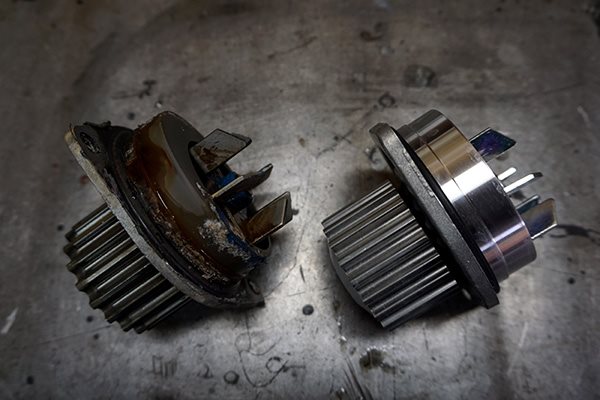
You book a timing belt replacement and see a water pump listed on the estimate. The pump hasn't left a puddle in the driveway, so the extra part seems unnecessary at first. Yet the pump and belt are closely connected on many engines, making their service timing an important decision. The key is checking your engine's actual layout, because the recommendation doesn't apply equally to every vehicle.
Why the Pump Often Shares Timing Belt Labor
Some engines use the toothed timing belt to drive the water pump along with the camshaft. The pump then sits behind protective covers and alongside belt tensioners and pulleys. Reaching it requires much of the same disassembly performed for a timing belt change. If an old pump fails shortly afterward, the owner faces another labor-intensive visit to reopen the timing system.
Other designs use an external accessory belt or an electric pump, and some rely on timing chains. A blanket recommendation without identifying the engine isn't enough. We confirm the pump drive method, its accessibility, and any manufacturer replacement guidance first. Shared labor is the practical reason a water pump frequently belongs on a timing belt estimate, not the assumption that every old pump is already defective.
Water Pump Bearings and Seals Continue to Age
A water pump pushes coolant through the engine and radiator to carry heat away from critical components. Its shaft and bearing assembly turn for thousands of hours, while internal seals hold coolant under pressure. Eventually, those parts wear out. A dry-looking pump still has years of service behind it. The new timing belt won't reverse bearing wear or refresh the pump's internal seals.
A leaking seal sometimes leaves dried coolant residue before a puddle appears. A rough bearing sometimes produces noise, but many pumps fail without an obvious early warning. During an inspection, we look for evidence of seepage, play, and contamination where the design permits. Age and access help determine the recommendation when the pump still functions normally.
Pump Failure Can Affect More Than Cooling
A deteriorating pump often causes coolant loss or poor circulation, which raises the risk of overheating. On engines where the timing belt turns the pump, a seized or damaged pump can interfere with belt operation. Coolant escaping into the belt enclosure may damage belt material. If timing is lost on an interference engine, valves and pistons can contact each other and cause internal damage.
Those outcomes aren't inevitable, so testing needs to establish the condition of the components. A high temperature reading alone doesn't distinguish a thermostat, radiator, cooling fan, or trapped air. Replacing a water pump won't repair every overheating problem. But when the pump belongs to the timing-belt drive, renewing an aging unit while the belt is exposed avoids dismantling the same area again after a pump failure.
The Timing Belt Kit Is More Than One Belt
Tensioners, idler pulleys, and guides keep a timing belt aligned and under proper tension. A new belt can't compensate for a seized idler or damaged tensioner. Timing kits supplied for a particular engine often include those wear components, and some kits include the pump. Using the correct parts and following the installation procedure are essential for preserving valve timing.
Ask what is actually included in the estimate. A lower price that excludes critical hardware isn't necessarily the better service. Some engines call for new fasteners, special holding tools, or a precise tension adjustment sequence.
Our inspection includes components accessible during the repair and any evidence of oil leakage near the belt. Oil contamination needs correction before new timing parts are installed.
Coolant Choice and Bleeding Are Important
Pump replacement involves coolant handling and sealing work, not simply bolting on a new housing. The cooling system needs the manufacturer's approved coolant specification, the correct seal, and carefully cleaned mating surfaces.
Improper sealant use or damaged gaskets create leaks. Air trapped after refilling sometimes causes temperature fluctuations and weak heater output, even when the new pump is working correctly.
We check for leaks after warm-up and confirm that coolant circulates and the engine holds a normal temperature. Depending on the vehicle, the bleeding procedure requires special equipment or a specified sequence on some vehicles. If a previous cooling problem caused overheating, the radiator, thermostat, and related components need evaluation too. Good maintenance addresses the complete cooling circuit, not only the part listed on the invoice.
When Replacing the Pump Might Not Be Necessary
There are exceptions to the usual combined-service advice. An independently driven pump that's easy to reach doesn't always justify proactive replacement during unrelated timing work. A recently replaced, documented pump in good condition also changes the discussion, depending on how its drive system is arranged. Engine-specific repair guidance takes priority over generic packages and sales claims.
Before approving the estimate, ask about:
- How the pump is driven on your exact engine
- The date and mileage of the last pump replacement
- The labor required to reach it during a later repair
- Tensioners, pulleys, seals, and required fasteners
- Coolant refill and final system testing
Your maintenance records help distinguish a sensible bundled repair from unnecessary parts. An inspection needs to explain the reasoning in terms you can follow, including any cost of postponing the pump.
Document the Repair and Protect the New Timing System
Once the belt and associated parts are installed, keep a record of the exact work performed. The record needs to identify the belt kit, water pump if replaced, coolant service, and date or mileage. The next owner or repair facility will then have more than a guess about timing belt history. Plan future maintenance around the correct engine schedule, not a generic mileage number.
When the cooling system stays sealed and the timing components work together correctly, you avoid one common source of repeat labor. The water pump often belongs with the timing belt because access and risk are linked. Understanding those connections helps you choose an effective repair without accepting an unexplained list of extra parts.
Get Timing Belt and Cooling System Inspection in Palo Alto, CA, With Palo Alto Shell
Palo Alto Shell in Palo Alto, CA, helps drivers plan timing belt replacement, inspect water pump condition, and review related cooling-system service. We'll explain which components fit your vehicle's maintenance requirements.
Call Palo Alto Shell or schedule a timing belt service appointment online.